
The Kansas total loss threshold is 75% of what your vehicle was worth immediately before it was damaged, and it comes from K.S.A. 8-197(b)(2)(B). What most explanations leave out is how narrow that rule is. It reaches only vehicles from the current model year or newer, plus the six before it, it specifically excludes cosmetic hail and wind damage, and it settles exactly one question: whether your title gets branded salvage. It does not decide whether your insurer writes your car off, and it has nothing to do with what you get paid.

What the 75% rule actually measures
The statute defines a late model vehicle as one whose model year is the year it was damaged or later, or any of the six years before that. A 2019 car wrecked in 2026 falls outside that window, so the percentage test does not apply to it at all. Older vehicles are judged under a different subsection, which asks whether the car is inoperable, missing required safety equipment, or needs substantial repair before it can be registered again. There is no percentage anywhere in that test.
Two more definitions do real work. Fair market value means retail value, taken either from a current nationally recognized compilation or automated database, or from a market survey of comparable vehicles with regard to condition and equipment. And the cost of repairs, which is the numerator, is narrower than your estimate total. The statute leaves out the cost of repairing, replacing or reinstalling tires, sound systems, and any sales tax on parts or materials. Sales tax sits on nearly every estimate written. If somebody has run a raw estimate total against 75%, the numerator is wrong before the arithmetic starts.
The hail exception Kansas wrote into the statute
The definition ends with a clause that matters a great deal in this state. A late model vehicle becomes salvage when repairs reach 75% of its value and the damage “was not merely exterior cosmetic damage to such vehicle as a result of windstorm or hail.” A hail dented car can carry an estimate above 75% of its value and still not be a salvage vehicle under that subsection.
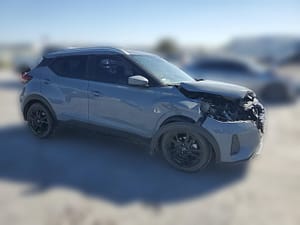
The word doing the work is “merely”, and the statute never defines it. There is no Kansas provision setting out where exterior cosmetic damage stops, so in practice it is argued case by case on the estimate. Dents in panels and paint are the easy end of it. The cracked windshield at the top of this page is the sort of damage that argument tends to turn on, because glass sits on the boundary.
Kansas earns the clause. On 19 September 2026 the NOAA Storm Prediction Center logged hail to 2 inches in McPherson County, a measured 81 mph gust near Hope in Dickinson County, and damaging wind reports out of 20 Kansas counties.
Why the Kansas total loss threshold does not decide if your car is totaled
Read the opening of the statute. Those definitions apply “as used in K.S.A. 8-197 through 8-199”, which are the salvage titling sections. They tell the Division of Vehicles when to brand a title. They are not instructions to your insurance company.
Then look at the subsection almost nobody quotes. A vehicle is also a salvage vehicle when it is one the insurer “determines is a total loss and for which the insurer takes title.” No percentage appears in that route at all. In practice an insurer will write a car off well below 75%, usually once the repair cost plus whatever the wreck returns at salvage gets past what the car was worth. That call comes out of your policy language, not out of the statute. So the 75% figure can be entirely absent from the decision that actually affects you.
The regulation that governs your payout
What lands in your account is governed by K.A.R. 40-1-34. Kansas adopted the NAIC Unfair Claims Settlement Practices Model Regulation of January 1981 by reference, then rewrote much of the automobile section itself. The amendments are where the useful numbers live.
Under Section 9 as Kansas adopted it, a comparable automobile means the same make, model, year, style and condition, including all major options on your vehicle. Your local market area is the 50 mile area around the place the vehicle was principally garaged. The valuation source has to provide values for at least 85% of all makes and models of private passenger vehicles for the last 15 model years, taking into account all major options, and it has to give values based on current data for that local market area. A cash settlement has to include applicable taxes, license fees and other fees incident to transfer of ownership. And any deviation from that method, “including deduction for salvage”, has to be “measurable, discernible, itemized and specified as to dollar amount”, has to be “appropriate in amount”, and the basis for it has to be fully explained to you.
That 85% requirement gets misread often enough to be worth stating plainly. It is sometimes described as a rule that the comparables have to represent 85% of the market. It is not. It is a requirement about the database sitting behind the valuation, not about the handful of cars listed in your report.
The 30 day right of recourse
This is the most useful line in the regulation and the one people are least likely to have heard of. If you cannot buy a comparable vehicle for the amount of the claim draft, and you say so to your insurer within 30 days of receiving that draft, the insurer has to reopen the file within five business days. It then either pays you the difference between its own market value and the cost of the comparable vehicle you located, negotiates and effects the purchase of that vehicle for you, or offers you a replacement.
Two details decide whether that actually works. The clock runs from the claim draft, not from the valuation report, which are often weeks apart. And the right is built around a specific vehicle you have gone and found. An argument that the number feels low is not the trigger. A listing for the same make, model, year, style and condition, with the same major options, inside 50 miles of where the car was kept, is.
Where these valuations come apart
Valuation reports arrive with two condition deductions that read like one idea. The Uniform Condition Adjustment is a flat amount taken off every comparable to bring dealer advertised prices down to normal wear. It says nothing about the car you owned, and it is rarely where a claim actually moves. The Component Condition Adjustment is the only line on the report that describes the vehicle you actually owned.
On the reports that come across our desk, that component line is almost always zero. It helps to know what a non zero one looks like. In Signor v. Safeco (11th Cir. No. 21-13148, decided 3 July 2023), the uniform adjustment came off 12 comparables at $1,064 each, while the component adjustment ran the other way as a $589 increase, because that vehicle was recorded as being in above average condition. A zero on that line does not mean your car was average. Most of the time it means no finding was written down.
That is the line to ask about, and Kansas hands you the words for it. A deduction has to be measurable, discernible, itemized and appropriate in amount. So does a salvage deduction, if you are keeping the vehicle. Then check where the comparables were pulled from, because the regulation defines your local market area as 50 miles from where the car was kept, not the whole state. If your car lived in Wichita, comparables pulled out of Kansas City or Tulsa are not in your local market area.
None of this tells you what your own claim is worth, and none of it is legal advice. It is the paper trail. If an offer is already sitting in front of you, the quickest useful thing you can do is work out which of those two condition lines a deduction came from, and whether the comparables were pulled from inside your 50 miles. We go through the first of those in Total Loss Condition Adjustment: Where to Push Back, and the options once you have decided the number is wrong in What to Do If You Disagree with Your Total Loss Settlement. If you would rather have somebody else build the file, that is what our Kansas total loss appraisal work is for.